Tuesday, April 03, 2007

Biodiversity - The Inverse Main Point


The blogosphere is full of much talk of environmental issues.

GW (or global warming) seems to take the cake for popularity. The fear factor and much media hype are partly responsible for the focus on GW even though one admits that the overall concern may be a very valid one.


But, for the biosphere, what are the real issues and environmental concerns?


If I had to pick the one greatest concern it would be the growth of
bioinversity / the loss of biodiversity.

I prefer the previous term as more descriptive of what is actually happening - species of all sorts are disappearing once and for all.
It is frightening. Bioinversity means that ecosystems will die, for
the interdependencies are huge.
We won't notice the changes
overnight but our children,
and theirs in turn, will curse us as
the blindest of fools!


Digg!

Sunday, April 01, 2007

LD1 - DYSLEXIA

There are many, many things that can disturb a child’s ability to learn. The commonest cause of learning disorders is improper development but genetics is also thought to play some roll…

Today, I want to highlight reading difficulties or dyslexia as a common and troubling disorder.

Signs can be detected from about 3 years of age onwards as children fall behind their peers in reading. Commonly one will encounter any or all of the following:

  • May have poor reading ability or poor comprehension
  • May often misread information
  • May have problems with syntax or grammar
  • May confuse similar letters or numbers, reverse them, or confuse their order
  • May have difficulty reading addresses, small print and/or columns

The amount of disability and its causes will have to be determined by experts individually for each child. Various standardised tests are available to help with the diagnosis. Depending on the cause, many childrens’ disability can be lessened or even sometimes eliminated. Early detection and treatment are keys to success but our experience at Challenge is also that it is better late than never!

Dyslexia IS TREATABLE!

Almost every town now has professional help available for affected children. To ignore a child’s difficulties will simply consign them to a life far below their true potential. Any child that is considered "slow", or "disorganised" (stupid, dumb... are words that should never be used of any child!) should be screened for a learning disorder.

If you have questions please do feel free to contact me (my email address is down in the footer) or post your question as a comment here.

I will soon do short highlights on each of the following - Dysgraphia, Dyscalculia, Dyspraxia, ADHD, Autism and Aspergers, nutrition for kids with LD, and finally a few posts on tips for parents and especially for those who do not have access to professional help, at PonnVandu, so please follow the rest of this fascinating series there...


Digg!

Saturday, February 24, 2007

Birds and Elephants at Topslip

Do you know that India boasts over 1,400 of the world's 10,000 species of birds? Of these fully 260 species can be seen in the Indira Gandhi Wildlife Sanctuary - one small 500 sq km patch of forest! Serious birders from all over the world visit here every year to enjoy the myriad and unique birds found only in the various remaining small patches of shola forest.

Ponnvandu (our little trust) organised 15 volunteers from our college student work to participate in this year's elephant and bird counts. It was an exciting two days. Most of our kids are getting into the forest on foot for the very first time! Some are so city bred that they have never even seen the milky way before...

We were blessed with lovely weather. Five of our volunteers were needed for the elephant census and the rest were assigned to enumerate the bird species. Only four of us are decent birders so we decided to form three teams and divided the sholas amongst the three for two days of morning and evening counts. It is exciting work! The forest department lorry drops us at specific points in the forest and from then on we work with the local tribal guides and forest guards to complete routes of 7 to 10 km each in the early morning and then starting again in the late afternoon.

The five that went for elephant counting saw a total of 39 elephants, which is quite encouraging given that this is a dry season census and most elephants are known to head deep into the forest in search of perennial streams and lakes (few and far between). A number of calves and juveniles were counted in the family groups. One young man found himself just feet away from a late foraging sloth bear while he was absorbed in observing a mother and calf elephant. Luckily these bears are very short sighted and it went harmlessly on its way.

Our budding birders quickly got the hang of things, started recognising bird song and we came up with a very encouraging 87 species including many of the rarer birds. The group that first went into the Karian Shola were able to see two nesting Malabar Pied Hornbills (Anthracoceros coronatus) and one male actually feeding the ensconced female - a very very rare treat indeed. They also spotted the very hard to find Ceylon Frogmouth (Batrachostomus moniliger) on this same hike. One group came across the 'dreaded' king cobra up close (a 4 meter/13 footer, about medium sized). This is one species that eats only other snakes. The king cobras come to the bamboo breaks and near spots of water for their breeding season and they can get quite aggressive if someone is found near their nests!

On the second day we were joined by the world famous bird guide (now a forest dept guard) Mr. Natarajan. He is amazing and being a local tribal, knows both these forests and the resident wildlife intimately. Articulate and a wonderful teacher, the lucky five kids that spent the day with him really got a grand education in censusing, bird identification and generally how the whole ecosystem works.

Having these young people from the Sri Krishna College of Arts and Sciences (SKCAS) enthusiastically participating in very rigorous census work was perhaps the most exciting part. They learned a tremendous amount, but more than that they got the feel of what biodiversity means, how fragile these ecosystems are and the crying need for more involvement in conservation work.

One of the saddest findings was that many areas of shola are being invaded by coffee plants. Coffee seeds from the surrounding private coffee plantations are being effectively dispersed into these sholas and one can see that the shola forests are under a very severe threat from this new invasion. Sometime soon I will do a post on what shola forest is, but so far the main point is that we don't have any idea how to regenerate a shola, so once gone, gone forever.

Digg!

Sunday, February 18, 2007

Bison's Charge - A Tall Tale

In line with our focus on forests and animal censuses, here's another true story from a few years back.

Roy (Aruna's cousin) decided to join me for a census and we headed to Mudumalai. Roy is a young man, Chennai born and bred (i.e. big city). This was his very first time in a real forest and we were both looking forward to it. The real beauty of these animal/bird counts is that one is given a route to follow and allowed to walk. If you go to any of our national parks as a tourist, walking is banned! One can only get into the forest in the Forest Department's own vehicle and that too on a fixed, well travelled route.

Hiking into any of the woods in South India is a glorious experience. Ancient lichen coated, orchid draped trees, sholas, myriad birds and even the undergrowth is wonderful with mosses, liverworts, cycads and ferns to fascinate. it does not really matter whether one does see much in the way of animals - spotted deer and monkeys (macacques or langurs) are hard to miss - still it is an enthralling and enlivening experience.

On the very first day we ended up in different teams. There were too few volunteers. On the second day though, a few more people showed up and we were together. On his first day's trek, Roy's forest guide had found them a huge hive of mountain honey and they had seen a few elephants. Roy was now hooked!

We started out bright and early with a forest guard who was a bit of a reluctant (and noisy) walker. With encouragement and perseverance we made good headway, moving through the open teak forest at the periphery and were soon going into a fairly dense forest. After a couple of hours the route led us downhill. We could hear a small stream chuckling in the depression ahead and about 100 yards from the bottom the trees opened up and we were on grass. Roy and I were abreast leading the way, with our 'guide' quite a bit behind us. There was another group somewhere East of us, they had been dropped a half kilometer before us and so we were the last to start.

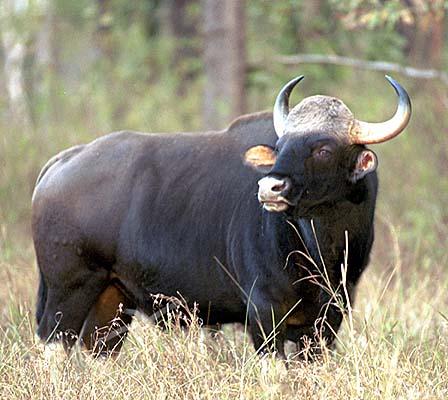
The bottom of this small valley was fairly open with a few small shrubs and plenty of grass. The rivulet of pure mountain spring water looked inviting. We were thirsty and speeded up down the slope when suddenly there was a burst of commotion on the far side of the clearing and charging straight towards us thundered this massive gaur bull (Indian bison, Bos gaurus). Now these are huge animals, the largest of the bovines, easily weighing in at over a ton a piece and muscularly built - one ton of pure muscle!

He was going full tilt, jumped the rivullet and started up the slope, saw us standing startled into stillness and slack jawed not 30 feet ahead. He came to a sudden halt and there occurred again one of those frozen moments. He stared, he snorted, we were barely breathing. Abruptly, he turned and trotted rapidly back the way he had come leaving us still gaping. If he had decided to continue his charge, I wouldn't be here to blog about it!

He was almost black with huge humped shoulders and rippling with muscles. Four white socks looked incongruosly cute and his neck - wow! The pics here do not do justice to seeing one of these 6 1/2 feet tall monsters up close.

Our guard had stopped at the beginning of the clearing and he now came hurriedly down and tried to persuade us to head home. We were only half way through our prescribed route and both of us flatly refused.

Seeing people in the deep forest is very rare and it looked as though this gaur bull had been frightened by the previous group and had been making tracks away from their ramble when he suddenly ran into us. He must have wondered how his persuers had managed to get ahead of him and cut him off again!

Luck was certainly with us, for the lone bull bison is considered the most dangerous of the forest animals. They almost never have human contact, being generally very shy behemoths of the very deep forest where even poachers rarely venture (an exception to this is Topslip).

The rest of our trek was anticlimactic!

We were surprised to see the amount of cattle droppings on the periphery of the forest range. It turns out that the government actually licences the native tribals to herd cattle within the forest, but, quite naturally, these licences are abused by local non-tribal heavyweights who buy out or extort the licences and then use them to allow large herds of cattle to forage within the forest itself.

Incidentally, Roy is now well settled in Switzerland. He and Akila (and their beautiful baby Leah) had come down this Christmas and we got to spend a brief time together in Chennai. Roy has certainly not lost the forest bug! We are going to try to schedule his next visit so that he can 'do the census' again!

Digg!

Friday, February 09, 2007

And Now, the Elephant -CHANGE IN DATES!!

The final stage of the census this year will be the elephant count on (CHANGE!!) TUESDAY & WEDNESDAY, FEBRUARY 20th AND 21st. This will be the last activity in this zone of forest as they shut out all visitors for the next two months during the summer fire season. A BIRD CENSUS WILL ALSO BE CONDUCTED AT TOPSLIP (ULLANDY RANGE).

An interesting contrast between the African and Asian cousins can be seen in these two pics: Can you make out which is which?

Those interested in participating please mail me with your contact details IMMEDIATELY!


Below is a map that depicts the contracting range of the Asian Elephant.


Along the borders of the black zones (is all that's now left) there are frequent clashes (man-animal conflicts) as the elephants try to walk through human settlements and plantations.

Elephants love to walk and can cover 40 to 50 km in a day especially when they are searching for water or better vegetation.

Our count takes place in the South West corner of India, in the heart of theNilgiris biosphere.

Sorry for those whose travel plans have been spoiled by the last minute change in dates. This sometimes happens when working with the Forest Department and we just have to grin and bear it!


Digg!

Wednesday, January 24, 2007

IGNWS Animal Census 2007

This year's survey was announced rather suddenly today. Under the aegis of the Ponnvandu Foundation we have been asked to provide volunteers. Lion Tailed Macaques (LTM - Macaca silenus) will be surveyed on Thursday the 25th of January, Nilgiri Tahr (Nilgiritragus hylocrius) on the 29th, carnivores from the 2nd to the 9th of february and elephants in Feb's 3rd week.

Anyone who wants to participate can contact me with their details ASAP!!!


The Tahr and the LTM are very highly endangered species and one has to trek to really deep forest to get a chance to see them.


Great trekking and a 'few in a lifetime' chance to see two of the world's most endangered species and to contribute to their conservation - could anyone ask for more?

Digg!

Saturday, January 13, 2007

PREMEDITATED OCEAN RAPE

The Gulf of Mannar lies just East and South of the temple town of Rameshwaram on the S.E. coast of India. The region has been declared a biosphere of great importance to the entire Indian Ocean and was the very first declared UNESCO recognised biosphere reserve (1989). It may well qualify as the world's richest area of marine biological resource. There is a particularly rich diversity of ecological niches including 21 uninhabited islands, with estuaries, beaches, forests of the nearshore environment, with marine algal communities, sea grasses, coral reefs, salt marshes and mangroves!
The sea cow, Dugong dugon (related to the manatee), with child - a very rare sight these days

There is a combined flora and fauna of more than 3,600 species represented here within an area of 10,500 sq km. Many of these species are endemic to this particular area of shallow ocean and include a number of critically endangered species (see the Red List). Just one example on the island of Kurusadai, less than a kilometre from the Indian mainland, is the world's one and only outpost of a subspecies of Ptychodera - a hemichordate ('acornworm') found nowhere else! New species and subspecies are constantly being 'discovered' in this area while simultaneously a number of previously common endemics seem to have completely disappeared.

The area also traditionally provides a rich and renewable source of food and livelihood to over 3 million native fisherfolk along our Indian coastline. Over the last decade, mechanised trawlers and biodegredation have been driving many of these families into penury.
Right through the heart of this precious and already highly stressed zone, our wise government proposes to carve out a channel, wide and deep enough to allow large, ocean going vessels easier access to India's ports. The ships will therefore be able to completely bypass the trip around Sri Lanka.
The Tsunami did its share, coming as a boon to the promoters of the 'S' project because the native fisherfolks, who were the most vociferous objectors, have been effectively driven from their villages and are reduced to living off handouts. And this does not take into account the coastal population on the other side of the gulf where lies Sri Lanka (Ceylon), who are even worse off due to the ongoing civil war there that compounds the devastation left by the Tsunami.
The Sethusamudram project further calls for continuous dredging of this canal which will result in huge quantities of silt continuously being spread throughout, destroying not only sea grass but corrals and algal growth also. The algae,plants, and corrals are the backbone of the whole food chain - with all opposition silenced we are staring at a scenario of total destruction of entire livelihoods, habitats and ecosystems.

The fact is that organised overfishing and almost no protection for the fragile reserve has already resulted in massive destruction of corral and mangrove, the two most precious ecosystems, which together account for 90% of the area's biodiversity. Unrestrained blasting and harvesting of corral to feed hungry cement plants, overfishing mainly due to the extensive use of trawlers by multnationals (for export) and specific destruction such as the targeting of sea cucumbers, ornamental fish, crustaceans (prawns, lobsters, crabs), turtles and sharks (both for soup!), have all taken a heavy toll on this unique and irreplaceable "biosphere".

Perhaps most shocking is the studied silence of the U.N. and almost all organisations involved in promoting conservation / biodiversity. Our government claims to have extensively studied the project's environmental impact but in the face of their winking at the daily destruction one wonders what it is that they have been claiming to conserve!
The fact is that mega projects like this one mean mega bucks for all the private and governmental players. In the face of such gross shortsightedness (not to mention greed), the world's bioinversity can only multiply apace.

After carefully studying the issues I urge you to
OBJECT TO THE SETHUSAMUDRAM PROJECT!

PLEASE JOIN TOGETHER TO OPPOSE THE RAPE OF THE GULF OF MANNAR and of any of our oceans in whichever corner of this globe you may happen to be...


Posts that contain Sethusamudram per day for the last year.
Technorati Chart
Get your own chart!

Digg!

Monday, December 04, 2006

SCIENCE AND FAITH

Strange bedfellows / an odd couple, or is it just me? Having faith in God is often challenged as being unscientific so, how does one live with ones faith in a transcendent God while accepting science as meaningful?

Somehow I have a feeling that the wrong questions are being asked. What could be more natural than to believe in God as creator and sustainer of everything in the universe if this is indeed true? God works and that's why the universe works. But then science should be able to test this hypothesis and prove it one way or the other.

Some scientists demand that they should be able to test any hypothesis to see if it is workable and to determine if it is the best hypothesis to explain whatever phenomena are being studied. This too may be a false start. I don't believe that God is a studiable 'phenomenon'. I don't see any reason why he should be, do you?

To my mind, the fact that there is matter and the fact that there is energy and the fact that there is time and ... all point me to God. Things are there to be studied and there to be understood only because God made it so.


This is an unusual post for this blog. Very abstract. But, very important. It's important because I see two disturbing tendencies. One is to make science and God adversaries, the other is to say that these are two separate worlds of thought that do not intersect. The consequences of either approach is bound to be poor science and a god who occupies the scientific gaps. neither this science nor this god have any worth!

Digg!

Thursday, November 23, 2006

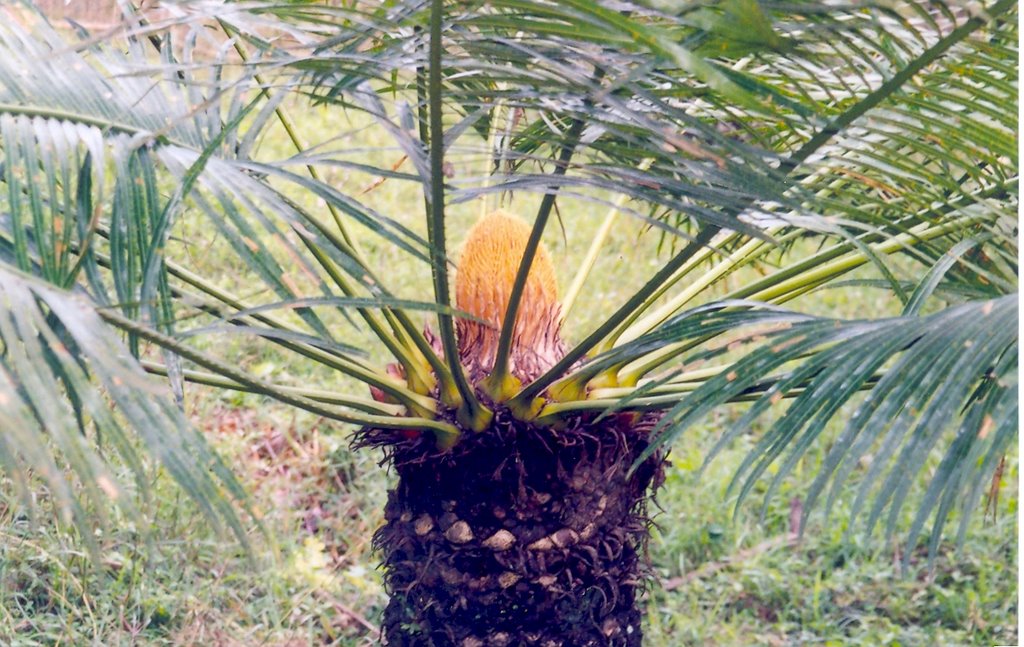
Stunted Palm, Hefty Fern? No, it's a CYCAD!

We were so excitedly lucky to see a stand of native Indian cycads - Cycas circinalis - in the Anamalais Hills recently (top).

My second year at college and I was in a quandary. The unlikely result was a course in plant morphology! I thought I knew a lot about plants and thought them much less interesting than animals but soon discovered the depths of my ignorance.

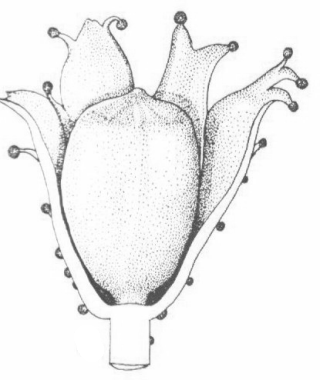
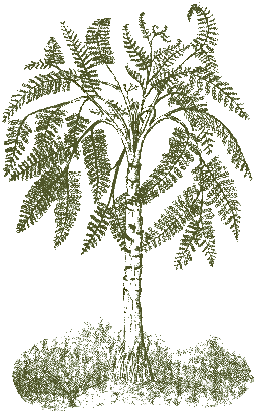
One of the fascinating groups of plants that Dr. Jerry A. Snider introduced to us was the Cycadales. Cycads, as they are commonly known, seem to have been around for at least 300 million years! They were an important part of the flora of the Carboniferous and Permian periods and formed a portion of the vast forests that we now mine as coal. The dominant plants back then included the Lycopsids (club ferns - some small relatives still survive), and other 'fern allies' including the Seed Ferns (now extinct, illustrated here, left and right) along with early relatives of the Gymnosperms (Pines and connifers).

Cycads are considered to be "living fosssils" along with Gingko, Araucaria and fern allies like the club ferns, horsetails, Sellaginella and so on...
Cycads seem somewhat in-between the ferns and the connifers / flowering types, which we often think of as 'higher' plants.
Most wild Cycads are rare, even in tropical lands but especially so in temperate areas, so it was a great pleasure to see healthy Cycas circinalis in these forests.
The commonest Cycad is a gardener's favourite, Cycas revoluta.

Odd looking creatures that resemble stunted palm trees, the cycads are often mistaken for palms. They have male plants and female plants that produce the most fascinatingly unusual male and female 'cones' for reproduction.
Another strange feature is that the fronds (leaves) unfurl very much like a fern's fronds do - what botanists call circinate vernation. It is beautiful to see little shoots like stumpy fiddleheads slowly unrolling into magnificant full-scale fronds. Supposedly a sign of 'primitivity', such unfurling is also shared by some connifers like Araucaria (Newfoundland Island Pine) and the ferns allies.

Along with other rare and beautiful species (like tree ferns - see Cyathea, below) that occupy the understory of 'old' forests, the cycads are dying out due to deforestation.
Bioinversity marches on!
The cycads are even more endangered as they are very, very slow growing. Something a meter high may be 100 or more years old! Once a few are destroyed they will take literally centuries to regrow!

Wonders of God's creation and signposts of biodiversity, these are creatures to be treasured!

Digg!

Thursday, November 09, 2006

The Little Black Boy


It's the women and children being targeted again, this time in Palestine and by the Israeli army!
Action - reaction - over reaction is a common sequence in human history, but this is getting to be ridiculous. The easy target, the easy way out, no risks involved, no rubber bullets, just kill!


Click on the image, which is a facsimile of one of Blake's original publications, to read the poem - on display at the Tate (London).
The title links you to the Tate's electronic page of Blake's work, showing his original plates too!
Digg!

Friday, November 03, 2006

Treetops and Topslip

Getting into the forest is the most rejuvenating experience possible!


Topslip is the main outpost of the Indira Gandhi Wildlife Sanctuary, A national park administered by the Tamil Nadu Forest Department in the Western Ghats Catchment area of the state, bordered on the West by the Parambikulam sanctuary in Kerala and on the East by the Anamalai hills.

The entire complex is a very precious reservoir of biodivarsity for an ecosystem that includes one of the only remaining regions of tropical rainforest, truly unique shola forests and medium montane grasslands. The last real populations of the Nilgiri Tahr (a type of mountain sheep/goat - Nilgiritragus hylocrius) are to be found in the upper reaches of these very habitats in isolated pockets of the Western Ghats biosphere.

Arriving on Wednesday, we spent one night at the Chital Forest Lodge and the next morning were given a rare oportunity to experience the newly built Treetops Suites. These are real treehouses placed, seemingly precariously, on stilts of living teak trees, the suites are comfortable and include functioning bathrooms and even hot water!
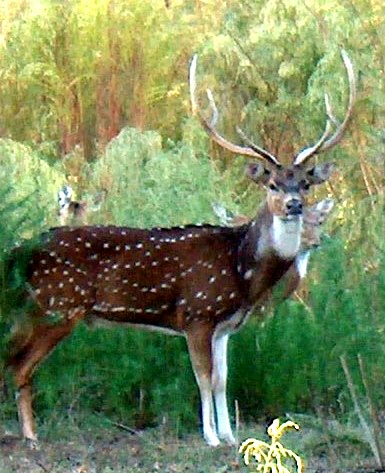
The evenings were misty and with the onset of the monsoons, we had periods of heavy rain followed by intervals of light drizzle. The spotted deer and wild boar were out in force and the population of the Nilgiri Langurs (Trachypithecus johnii) seems to be very healthy in this forest but they are endangered due to habitat loss and poaching as it is rumoured that their flesh has aphrodisiac properties.
We were surprised by a herd of the endangered Kaattu Erumai (Gaur, Indian 'Bison' - Bos gaurus) who wandered through the camp on the second day. These are massive beasts with the bulls weighing in at over a ton, beautifully marked, generally shy and found only in deep forests, it was a treat to watch them calmly walking through.
The nights were very special. A serenade of insect, tree frog and barking deer calls, with lowering mists and very faint moonlight filtering through. The barking deerMuntiacus muntjak) were obviously tracking larger predators, either leopards or tigers.

Oh, the smells! Delightful wafts of wildflowers, honey, ripe fruits and spices; clean healthy air to relish breathing.

All of our attempts to enter the Karian Shola were dashed by the spells of pelting rain. This patch of Shola is very special as it is one of the last resorts in India for the Ceylon Frogmouth (Batrachostomus moniliger) a fascinating bird that mimics dead leaves so perfectly that it is hard to spot even from a few feet away!

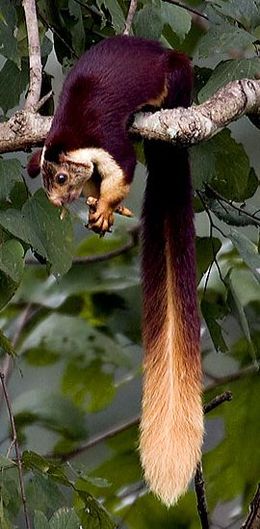
Just as we were getting ready to leave, Sellamuthu, the Treetops' Forest Guide, pulled us out to watch a pair of giant malabar squirrels (Ratufa indica) gambolling in the tops of the nearby teak trees. They were having fun chasing each other around and making incredible leaps from branch to trunk completely oblivious to the fact that they were a good 100 ft up.

Even in these aparently rich forests man's ravages are very evident. Large plantations of teak tree monocultures have replaced a highly diverse forest ecosystem. Attempts to propagate the forest species of trees have been failures and it is becoming obvious that climate change is inimical to the original habitats. The planted seedlings simply don't survive.

In oder to try to promote diversity, species of bamboo have been introduced but introduced species usually create their own imbalances.

We are witnessing bioinversity in action.


So, we take our children to these forests, knowing that our grandchildren will not see anything resembling them at all.

Thanks to Pandiyan for the nilgiri langur pic.


Digg!

SHARE THIS NOW

Google+ javascript:(function(){var now=new Date(),month=now.getMonth()+1;day=now.getDate();year=now.getFullYear();window.polarbear=window.polarbear||{};var D=550,A=450,C=screen.height,B=screen.width,H=Math.round((B/2)-(D/2)),G=0,F=document,E;if(C>A){G=Math.round((C/2)-(A/2))}window.polarbear.shareWin=window.open('https://www.polarbearapp.com/app','','left='+H+',top='+G+',width='+D+',height='+A+',personalbar=0,toolbar=0,scrollbars=1,resizable=1');E=F.createElement('script');E.src='//www.polarbearapp.com/js/web-bookmarklet.js?v='+month+'-'+day+'-'+year;F.getElementsByTagName('head')[0].appendChild(E)}());