Roy (Aruna's cousin) decided to join me for a census and we headed to Mudumalai. Roy is a young man, Chennai born and bred (i.e. big city). This was his very first time in a real forest and we were both looking forward to it. The real beauty of these animal/bird counts is that one is given a route to follow and allowed to walk. If you go to any of our national parks as a tourist, walking is banned! One can only get into the forest in the Forest Department's own vehicle and that too on a fixed, well travelled route.
Hiking into any of the woods in South India is a glorious experience. Ancient lichen coated, orchid draped trees, sholas, myriad birds and even the undergrowth is wonderful with mosses, liverworts, cycads and ferns to fascinate. it does not really matter whether one does see much in the way of animals - spotted deer and monkeys (macacques or langurs) are hard to miss - still it is an enthralling and enlivening experience.
On the very first day we ended up in different teams. There were too few volunteers. On the second day though, a few more people showed up and we were together. On his first day's trek, Roy's forest guide had found them a huge hive of mountain honey and they had seen a few elephants. Roy was now hooked!
 We started out bright and early with a forest guard who was a bit of a reluctant (and noisy) walker. With encouragement and perseverance we made good headway, moving through the open teak forest at the periphery and were soon going into a fairly dense forest. After a couple of hours the route led us downhill. We could hear a small stream chuckling in the depression ahead and about 100 yards from the bottom the trees opened up and we were on grass. Roy and I were abreast leading the way, with our 'guide' quite a bit behind us. There was another group somewhere East of us, they had been dropped a half kilometer before us and so we were the last to start.
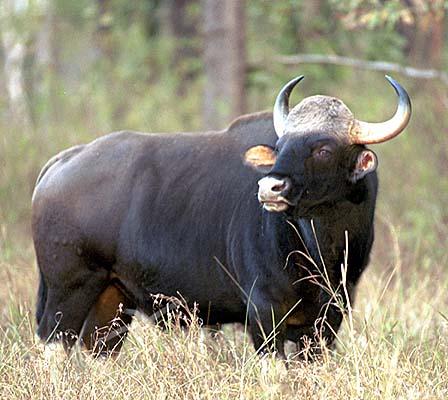
The bottom of this small valley was fairly open with a few small shrubs and plenty of grass. The rivulet of pure mountain spring water looked inviting. We were thirsty and speeded up down the slope when suddenly there was a burst of commotion on the far side of the clearing and charging straight towards us thundered this massive gaur bull (Indian bison, Bos gaurus). Now these are huge animals, the largest of the bovines, easily weighing in at over a ton a piece and muscularly built - one ton of pure muscle!
He was going full tilt, jumped the rivullet and started up the slope, saw us standing startled into stillness and slack jawed not 30 feet ahead. He came to a sudden halt and there occurred again one of those frozen moments. He stared, he snorted, we were barely breathing. Abruptly, he turned and trotted rapidly back the way he had come leaving us still gaping. If he had decided to continue his charge, I wouldn't be here to blog about it!
He was almost black with huge humped shoulders and rippling with muscles. Four white socks looked incongruosly cute and his neck - wow! The pics here do not do justice to seeing one of these 6 1/2 feet tall monsters up close.

Our guard had stopped at the beginning of the clearing and he now came hurriedly down and tried to persuade us to head home. We were only half way through our prescribed route and both of us flatly refused.
Seeing people in the deep forest is very rare and it looked as though this gaur bull had been frightened by the previous group and had been making tracks away from their ramble when he suddenly ran into us. He must have wondered how his persuers had managed to get ahead of him and cut him off again!
 Luck was certainly with us, for the lone bull bison is considered the most dangerous of the forest animals. They almost never have human contact, being generally very shy behemoths of the very deep forest where even poachers rarely venture (an exception to this is Topslip).
The rest of our trek was anticlimactic!
We were surprised to see the amount of cattle droppings on the periphery of the forest range. It turns out that the government actually licences the native tribals to herd cattle within the forest, but, quite naturally, these licences are abused by local non-tribal heavyweights who buy out or extort the licences and then use them to allow large herds of cattle to forage within the forest itself.
Incidentally, Roy is now well settled in Switzerland. He and Akila (and their beautiful baby Leah) had come down this Christmas and we got to spend a brief time together in Chennai. Roy has certainly not lost the forest bug! We are going to try to schedule his next visit so that he can 'do the census' again!