Showing posts with label biodiversity. Show all posts

Thursday, December 15, 2011

IT COSTS THE EARTH !

We take our earth so much for granted.

It's free to use, 'free' of cost, except for what we directly spend on reaping the earth's bounty.

But the earth's resources are not unlimited. The earth's resources are certainly not free.

Here's a TED presentation by Pavan that puts across to us the dangers of our assumptions:


If we keep on reaping where we do not sow, there will be less and less for our generation.

And future generations are losing forever what we so casually 'take' for granted.

First, the price will now be paid by the poorest and most vulnerable.

The biggest offenders are the big corporations and the governments that let them loot our present & our future for a pittance. 


LET'S MAKE A CHANGE 

Related post: http://bit.ly/tdxuJQ  whats-in-a-name


Thursday, April 14, 2011

What's In A NAME - Biodiversity vs Global Warming

"Tis but thy name that is my enemy" says Juliet to Romeo, and as it turns out, she's right, while Romeo ('that which we call a rose by any other name...') is dead wrong.

A LOT of people know what 'Global Warming' or 'Climate Change' is all about. At the same time, very few people have a clue that such a thing as 'biodiversity' even exists.

Not surprisingly, the percentage of people that have never heard of biodiversity is over 30% of a well educated population - the English.

I think it's a tragedy. Both GW (or 'climate change') and BD are important concepts. Both signify huge changes that are taking place right now on our planet.

But, to my mind, the impact of loss of biodiversity is a much, much bigger problem. Certainly more dangerous in the short term, and yet it is the area where individual humans can make an immediate change.

 With GW, while the awareness is good, and individuals can and should try to do their bit, the forces at work really do require global action. Individuals can have little direct impact.

On the popular level, it turns out that fully 30% of the respondents to the recent DEFRA survey thought “there is nothing I can do personally to help protect the UK's biodiversity.”


Looking locally, in India what we do deservedly see getting huge publicity, is the loss of our tigers. And that IS certainly of great importance. 

But, have you ever considered that we are concentrating on the species that sits at the very top spot of a huge ecological pyramid?   The land, the plants, the herbivores, the insects, the germs - entire ecosystems consisting of hundreds of thousands of individual species have to function perfectly and together to allow even a single tiger to survive in the wild. 

And we are blind to the loss of all these stepping stone species. 

It is mind boggling to imagine, but we are losing our biodiversity.

As we lose our biodiversity, so we will also lose our tigers... and it's not only the tigers we will lose!

The LOSS of biodiversity (and that's four words to describe a phenomenon) is so, so deadly. It's happening right now, all around you. But before we will start to do something about it, we need to understand and acknowledge that it is REAL.

Yet, sillily enough, I do wish there were a ONE WORD name for this phenomenon.

I really believe that a better name for biodiversity, something catchier, simpler to remember, unique, and meaningful, will make a huge difference to the amount of awareness. The fight to save the world's BD is of the utmost importance.

Please lend a hand, let's rename this thorny rose, let's start winning back our biodiversity - before it is too late - and we end up with only this...


P.S. I've tried BIOINVERSITY and that only adds to the confusion. Then there's ECOCIDE, but that seems too broad... so, what'll it be? 

You can do better, start now, find a word, or create one, and the whole world and all the creatures that now still inhabit this world will thank you!

A quick link via @greenroofsuk (Dusty Gedge) Michael McCarthy in the Independent "Nature Studies: Our generation has seen a great thinning that we can’t quite name" 
http://www.independent.co.uk/voices/comment/nature-studies-our-generation-has-seen-a-great-thinning-that-we-cant-quite-name-8426019.html

And if you have any doubts at all about the Earth now undergoing the sixth mass extinction in its history – the first since the cataclysm that wiped out the dinosaurs some 65 million years ago, then please read:


http://www.project-syndicate.org/commentary/mass-extinction-human-cause-by-paul-r--ehrlich-and-anne-h--ehrlich-2015-08#vGlkvtRrX1vHKDjW.99  
http://bit.ly/1TyiNRe


Sunday, May 20, 2007

BIODIVERSITY versus Global Warming

A lovely new tool for comparing up to three different blogworld variables is available on icerocket and I used it to see how biodiversity was doing in comparison to global warming in the blogosphere.

The result was disheartening. Folks are much, much more worried about a crisis that is yet to come than they are about an ongoing and potentially much more devastating one - loss of BIODIVERSITY!

I AM A BIT AT A LOSS. How does one convince people that we are losing species permanently on a daily basis? Once stable ecosystems are endangered and will be irrecoverably lost if we don't start taking immediate action. Once a species is lost it will never be regained and once an ecosystem is damaged by species loss, that ecosystem is doomed!

Here are the actual stats as of May 18th, 2007:

GW = Global Warming, B = Biodiversity and E = Endangered Species

Trend Terms......Posts per day..........Average %.......Total posts

GW.....................1,353.91................. 0.1791.............121,852

B..........................53.16....................0.0069...............4,784

E..........................96.30....................0.0127...............8,667

That's at present something like 25 times as much activity on GW than it deserves and biodiversity needs to get 50 times stronger...

Any Bright Ideas?

The minute you start getting concerned about bioinversity and start blogging on it and doing something about it, these stats will surely improve.

Digg!

Tuesday, April 03, 2007

Biodiversity - The Inverse Main Point


The blogosphere is full of much talk of environmental issues.

GW (or global warming) seems to take the cake for popularity. The fear factor and much media hype are partly responsible for the focus on GW even though one admits that the overall concern may be a very valid one.


But, for the biosphere, what are the real issues and environmental concerns?


If I had to pick the one greatest concern it would be the growth of
bioinversity / the loss of biodiversity.

I prefer the previous term as more descriptive of what is actually happening - species of all sorts are disappearing once and for all.
It is frightening. Bioinversity means that ecosystems will die, for
the interdependencies are huge.
We won't notice the changes
overnight but our children,
and theirs in turn, will curse us as
the blindest of fools!


Digg!

Saturday, January 13, 2007

PREMEDITATED OCEAN RAPE

The Gulf of Mannar lies just East and South of the temple town of Rameshwaram on the S.E. coast of India. The region has been declared a biosphere of great importance to the entire Indian Ocean and was the very first declared UNESCO recognised biosphere reserve (1989). It may well qualify as the world's richest area of marine biological resource. There is a particularly rich diversity of ecological niches including 21 uninhabited islands, with estuaries, beaches, forests of the nearshore environment, with marine algal communities, sea grasses, coral reefs, salt marshes and mangroves!
The sea cow, Dugong dugon (related to the manatee), with child - a very rare sight these days

There is a combined flora and fauna of more than 3,600 species represented here within an area of 10,500 sq km. Many of these species are endemic to this particular area of shallow ocean and include a number of critically endangered species (see the Red List). Just one example on the island of Kurusadai, less than a kilometre from the Indian mainland, is the world's one and only outpost of a subspecies of Ptychodera - a hemichordate ('acornworm') found nowhere else! New species and subspecies are constantly being 'discovered' in this area while simultaneously a number of previously common endemics seem to have completely disappeared.

The area also traditionally provides a rich and renewable source of food and livelihood to over 3 million native fisherfolk along our Indian coastline. Over the last decade, mechanised trawlers and biodegredation have been driving many of these families into penury.
Right through the heart of this precious and already highly stressed zone, our wise government proposes to carve out a channel, wide and deep enough to allow large, ocean going vessels easier access to India's ports. The ships will therefore be able to completely bypass the trip around Sri Lanka.
The Tsunami did its share, coming as a boon to the promoters of the 'S' project because the native fisherfolks, who were the most vociferous objectors, have been effectively driven from their villages and are reduced to living off handouts. And this does not take into account the coastal population on the other side of the gulf where lies Sri Lanka (Ceylon), who are even worse off due to the ongoing civil war there that compounds the devastation left by the Tsunami.
The Sethusamudram project further calls for continuous dredging of this canal which will result in huge quantities of silt continuously being spread throughout, destroying not only sea grass but corrals and algal growth also. The algae,plants, and corrals are the backbone of the whole food chain - with all opposition silenced we are staring at a scenario of total destruction of entire livelihoods, habitats and ecosystems.

The fact is that organised overfishing and almost no protection for the fragile reserve has already resulted in massive destruction of corral and mangrove, the two most precious ecosystems, which together account for 90% of the area's biodiversity. Unrestrained blasting and harvesting of corral to feed hungry cement plants, overfishing mainly due to the extensive use of trawlers by multnationals (for export) and specific destruction such as the targeting of sea cucumbers, ornamental fish, crustaceans (prawns, lobsters, crabs), turtles and sharks (both for soup!), have all taken a heavy toll on this unique and irreplaceable "biosphere".

Perhaps most shocking is the studied silence of the U.N. and almost all organisations involved in promoting conservation / biodiversity. Our government claims to have extensively studied the project's environmental impact but in the face of their winking at the daily destruction one wonders what it is that they have been claiming to conserve!
The fact is that mega projects like this one mean mega bucks for all the private and governmental players. In the face of such gross shortsightedness (not to mention greed), the world's bioinversity can only multiply apace.

After carefully studying the issues I urge you to
OBJECT TO THE SETHUSAMUDRAM PROJECT!

PLEASE JOIN TOGETHER TO OPPOSE THE RAPE OF THE GULF OF MANNAR and of any of our oceans in whichever corner of this globe you may happen to be...


Posts that contain Sethusamudram per day for the last year.
Technorati Chart
Get your own chart!

Digg!

Wednesday, September 20, 2006

Hotspots of Biodiversity

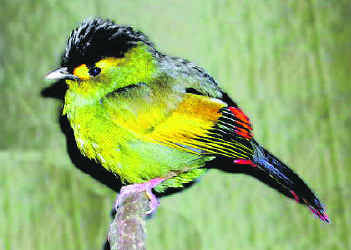
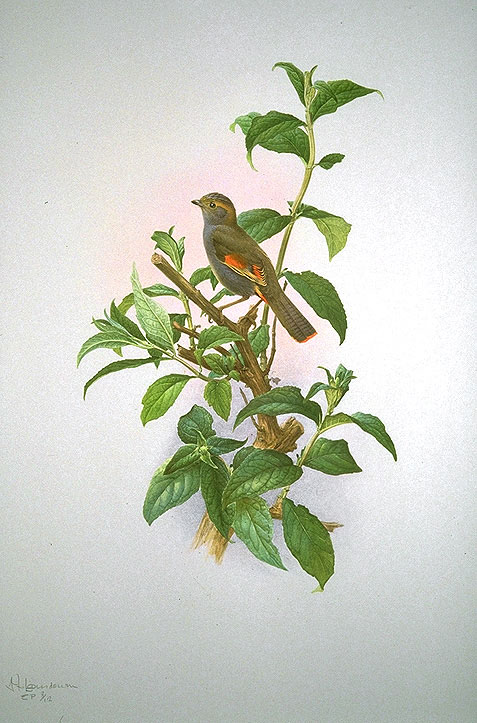
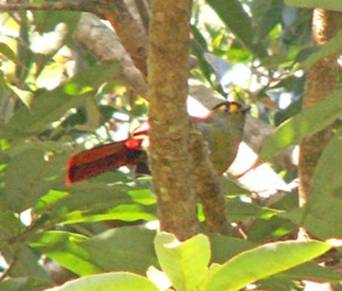
The recent discovery of a completely new species of bird from the remote Arunachal Pradesh (Himalayan foothills) in India reminds us that where man has not interfered much, the wilderness still can thrive.

Bugun liocichla is colourful. Initially it was mistaken for a Chinese species, the Omei Shan Liocichla, and it was assumed that a different race of that species had survived in a pocket over a 1000 km South of its known range.

Now that would be very unusual. The other possibility, that the species had spread South from the Shan would be even stranger!

With the world warming rapidly we are seeing the opposite! Temperate species are creeping North as the winters become milder while tropical creatures are extending their ranges. The nightmare for medical authorities in temperate countries is that very soon, tropically transmitted diseases, such as Malaria and Dengue will be commonplace in North America and Europe. The reason being that their vector - the mosquito - is already establishing populations much further North than ever before - simply because winter has become so much milder. In fact, the trend is so pronounced that the hottest specialty in medical colleges is now...Tropical Medicine!

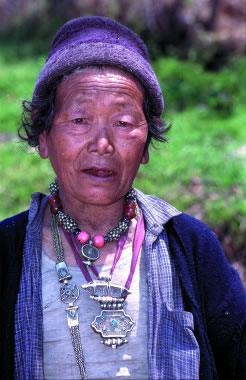
Getting back to Bugun, the new species has coexisted with a small tribe of the West Kameng district, quite naturally called the Bugun (or Khova) and hence the new name.

We have a common, noisy and gregarious cousin of this rare "babbler" in my area and we call that "the seven sisters" as they are always found in hyperactive bunches.

My own fascination for birds bloomed very late and I have to thank many people for having introduced me to the "world of birding"not least of whom is the amazing Dr. John R.W. Stott

Digg!

SHARE THIS NOW

Google+ javascript:(function(){var now=new Date(),month=now.getMonth()+1;day=now.getDate();year=now.getFullYear();window.polarbear=window.polarbear||{};var D=550,A=450,C=screen.height,B=screen.width,H=Math.round((B/2)-(D/2)),G=0,F=document,E;if(C>A){G=Math.round((C/2)-(A/2))}window.polarbear.shareWin=window.open('https://www.polarbearapp.com/app','','left='+H+',top='+G+',width='+D+',height='+A+',personalbar=0,toolbar=0,scrollbars=1,resizable=1');E=F.createElement('script');E.src='//www.polarbearapp.com/js/web-bookmarklet.js?v='+month+'-'+day+'-'+year;F.getElementsByTagName('head')[0].appendChild(E)}());