Showing posts with label snake. Show all posts

Friday, February 27, 2015

The Noble Indian Cobra!

She was a beauty! 5 feet if an inch and what I first saw of her was the typical wheaty look, with just a couple of inches showing.

It was not an ordinary day. The day before, I had taken a spill off my scooter, badly skinning both knees and the heel of my left hand . I'd gone to work anyway as we had an important meeting, but the pain killers wore out fast and I left as soon as I could to come and nurse my injuries in the peace of my own home. I'd just relaxed and taken my next dose when young Annamalai came and called from the gate. I dragged myself to the door to see a very excited young man saying there was a snake and right then a bike came up and the rider said 'hop on sir, we need a hand' so I stiffly and gingerly got my stuff together and clambered aboard.

Just inside our colony gate stood a Proclain and it looked like they had cleared quite a bit of scrub. In front of the Proclain was what was left of a largish termite mound topped with construction waste. The very top of that had been taken off and there, in a gap, she was pinned. I could see she was breathing, but the rest of her was firmly trapped within the collapsed mound.


I had a chat with the operator and he was confident that he could take off another layer without doing her any damage, and he did a precision job. 


I could now see a foot of her middle, as thick around as my wrist but which end of her was where was a mystery, so as gently as possible, I started taking  the dirt and waste tiles off both ends. After I had another foot or so of her exposed, from one end she got her head out and immediately flowed right off the mound at my feet. She was in excellent shape despite being nearly buried alive.

I was slow, and she was very fast. I had by now grabbed my stick and sack and was vainly trying to get her onto the stick as she went round and round both me and the mound looking for a way back in. After three rounds, she gave up on finding a hole and started looking for a way to get right out of there, but the ring of gawkers was solid and so she whizzed around passing twice between my feet as I hobbled and bobbled after her rather helplessly.

She finally took a run for open space, lifted her head, saw people and stopped, and in that moment of hesitation I had her on the stick and then thankfully she slid straight into my sack.

As the Proclain cleared the rest of the mound, we also caught 3 baby cobras, all about 2 feet long, and to my utter surprise 4 small foot-long kraits! All of these had been apparently happily residing together under that one big termite mound!

Once convinced that I really had them safe, the viewers finally stepped in and I showed them the beauty and the babies, now tossing around peacefully in the sack. Somehow, the onlookers had a feeling that I had been bitten, but I reassured them, and then thankfully headed back home. In fact that lovely cobra never once even started to spread her hood, she was simply intent on escape.

With the adrenaline pumping I'd temporarily forgotten my pain, but the minute I had them, the pain came back in a rush. Aruna was anxiously waiting, so I showed her the lovely big cobra and the bunch of shiny little ones and she calmed down a bit.

The next day it was a routine release out in a nearby reserve forest territory where the whole group of 8 disappeared into the scrub really fast.

That night I dreamt of snakes. In particular, in my dream was a big male cobra, who invited me to catch him and then asked to be left wherever I had left his mate. It was logical enough that a mother with babies had a mate nearby... and I told myself that that must have been what was behind my dream. Life returned to normal and I all but forgot my dream.

About a month later, at around ten at night, I was on the net, Aruna was watching Super Singers on TV and our son Rommel had gone out to get some milk. He suddenly burst into the living room and said, 'appa, come quick, there's another snake.' As a horrified Aruna watched, we grabbed torches, sack and snake stick and rushed off.

There were about 5 men standing around on the road outside a gate, They pointed to an area near the gate post and said they were sure that the snake was there. The area had some low weeds and lots of grass, so I gingerly started at one end and worked my way towards the gate. There was no sign of a snake. However, the men were certain that the snake must be there, so I started looking for any holes. The area around the front of our gated colony is riddled with termite mounds and as you know, that means lots of interconnecting chambers and passages well underground. I was sure that there must be an access point and we finally found it almost under a concrete slab. Peering in with a torch we could make out just a bit of the snake's head. I tried waiting it out but he wasn't budging. There was no way to move the concrete slab, so we used the water trick, ran a hose into the hole and tried to flood him out. After the area was flooded, he finally slowly came inching out. One of the men had armed himself with a heavy rod, and the message was obvious - either we got the snake or he would - permanently!

We let him emerge completely and then tried to get him onto my stick, but he kept sliding off (probably because he was still wet). He was big (5-6 feet) fast, and very agile, and Rommel with the sack and I with the stick were hard pressed keeping up with him. We let him run off the verge and onto the road and he was intent on crossing to the rough on the other side. Once there, he would be gone in a flash, so we kept herding him back as best we could until finally on the sixth attempt, he stayed on the stick and Rom had the sack ready and in he went.

We were winded, and it took a while to get our breaths back. We chatted with the gentlemen and they wanted to know how it was that whenever they had confronted cobras, the snakes always got angry and had their hoods up, hissing and threatening to bite, but with this snake, and the one in the mound, they never even started to spread their hoods and had just run. We explained to them that cobras always look for a way to escape and have no interest in confrontations. As long as we let them run, run they will! There was no magic, cobras have lived in and around humans for thousands of years and are well adapted, stealthy enough and aware of their human neighbours' schedules and so becoming nearly invisible.

Jobi with my snake stick
This huge fellow had been occupying space right at their doorstep for years without them ever even knowing. It was just his bad luck that the owner happened to come home later than usual that night on his bike and caught him in the headlight just as our hero was getting ready to go get his dinner...

That night, I had another vivid dream featuring snakes including some rather exotic ones too. I rarely remember my dreams for long, but this one stayed with me and suddenly reminded me of the earlier dream I had had about the first cobra's mate requesting a reunite. This handsome snake resided just 200 feet from the mound and looked about right to be that beau, so I silently promised him that he would be released at that very same spot.

As soon as my friend Jobi heard about our rescue, he offered to chauffeur me with the snake to the point of release. He also took a short video of the release itself and that's down at the end of this post.


As you can see, it's a lovely location. Wild elephants use this stretch to reach water so though not too far from the city, it's unlikely that there will be much real estate development around and except for a couple of temples, it's a pretty deserted area AND this is forest department protected land, so 'our' snakes (a number of whom we have released here) can look forward to peacefully hunting  their prey and rebuilding their families without fear of hasty and murderous humans!


As a family, we have had the privilege of rescuing quite a few snakes in and around our colony. In December ('14) alone.

Apart from the 8 we got from around that mound, there was also one big krait (perhaps whose 4 babies we relocated?) >>


and a 3 foot cobra that the kids picked up one night.


That means there's at least one other big krait around somewhere, and we've also seen a largish Russell's twice but she got off into thick brush before we could grab her.


In any case, as Lord Byron notes, true
"love will find its way
(The Gaiour)
I wonder, did they get back together - what do you think???


LABELS TAGS LINKS

#snake rescue #cobra #krait #Russells viper, reunite, snake dreams, release, forest, video, #termite mound proclain #Naja #Bungarus #Daboia #Rommel #Aruna #Jobi #Coimbatore

To see some of our other venomous snake tales check out
http://bit.ly/1GyNOu8
http://bit.ly/1AzyU5S
http://bit.ly/1GyOrns

Monday, February 25, 2013

Wolf Snake Rescued by the Kids


Our kids John Rommel, and Saranya Carr were at their friend Fara's house one night recently when someone outside started screaming "snake!" On rushing out the kids found a group of terrified people including Fara's mom having hysterics over a snake. The discussion was already on as to how they could best set it on fire and who was going to whack it!

After calming them down a bit, with the help of a backpack, the offender was coaxed into hiding in the bag by Vasanth, Saran, Rommel, and Manuraj, the bag zipped up, and our friend, as yet unidentified, was brought home.

We took a look under good light and it turned out to be a 2 foot wolf snake.

The Indian wolf snake (Lycodon aulicus) is a very pretty and nonvenomous snake that's actually fairly  common even in towns and cities. Human towns tend to have high populations of mice and rats, and are therefore attractive to snakes such as the wolf and trinket snake.

We did try to get the forest department to come and pick the wolf up, as that's the proper procedure, but they declined, so Rommel and his friend Dinu took our pretty wolf out to a nearby mountain  range where there's a good stretch of reserve forest and one very happy snake was released to the wild.


If you aren't too sure about identifying snakes and deciding whether they might be venomous, check out our earlier post to help you identify India's venomous Big 4  and to give you a few tips on dealing with snake bite - just in case!


Friday, January 18, 2013

Rescue that Snake!

Rescuing snakes (from dangerous humans) is something that one does whenever the opportunity presents itself. One morning, I got a call saying there was a malaipambu (python) trapped in an agricultural well not far from where we live. The call came while I was out shopping, so I rushed home, handed over the groceries, picked up my snake stick and prepared to head out to the coconut grove where the well was. My son John Rommel and his friend Dinu both tagged along, and that was our team.

Along the way, my autodriver spread the word (as had the farmer), so when we got there, there were about 30 onlookers. I had my doubts about this operation because it was a well, and our Indian wells are rather rough things with typically precarious means of access. This well proved to be no exception, about 60 feet across and sporting a rugged and steep descent cut into two adjacent walls, with the water about 50 feet down.

Anyhow, we slowly worked our way down and soon saw that the supposed malaipambu was actually a large 6 foot (venomous) Russel's viper. The farmer had wanted to clean the well (it was a mess) and that's when the snake was spotted and misidentified, but luckily none of his workers were willing to face even a smallish nonpoisonous python, so we had been called in.

Now, ordinarily the Russel's is a dangerous snake to tackle and big ones even more so. They have powerful thick bodies, and can launch a strike to about 3/4 of their lengths and generally strike upwards, so people often get bitten at or above knee height. The Russel's is also known to strike with little or no provocation, in common with the saw scaled viper (and most unlike the other two of the 'big 4' the krait and the cobra). Now, while there is excellent antivenin available to deal with the bites of India's big 4 (see my post on this), A Russel's bite also causes extensive local tissue damage and awful ulceration, so surviving the bite is only one part of one's recovery!

We were very handicapped by the tight constraints of the 'steps' and by the fact that we could only just barely reach the water about 4 feet down from the final step. To our advantage was the fact that the snake was in water, cooled down, and therefore a bit more lethargic than otherwise.

S/He was swimming around the edges of the well trying to find some way out. Soon after we got down, s/he came round and I tried to get him on my stick but this proved impossible. There was a heavy rope lying at our feet, so my next attempt was with a loop of this rope let into the water.


I managed to get him about half way along his body with the loose noose, but when he was just below us he slipped back down.

After a few minutes he came back round and this time, using my snake stick, I guided him into the noose and then supported his back end with the stick. Rommel was ready with a heavy sack and into this we gently let him down. The top of the sack was tied and we triumphantly ascended with our beautiful Russel's viper.

We got home with our in-sack snake, only to find everyone in a bit of an uproar. We had guests at home (the Bonneys, all the way from Australia) Aruna's aunt and uncle, and they were all in a bit of shock, so the snake was photographed 'in-sack' and then left safely out of sight as we tried to contact the forest department to arrange for them to pick up our prize. That night the forest department staff came and picked him/her up and that was a successful rescue!

Learn to identify India's venomous snakes

Tuesday, October 04, 2011

Snakes in the (Indian) Grass - The Big 4 - Dealing With Snakebites


A 'narcissistic' Indian Cobra
(Naja naja)
INDIA'S "BIG FOUR" VENOMOUS SNAKES


The Russell's Viper
Echis carinatus - the Saw Scaled Viper
Notice how variable the colouring can be.


Saranya, my daughter, did recover from a severely venomous Echis snakebite. It's part of the 'normal' risk for snake rescuers. That bite was the original driving force to bringing all the available information together in one place. As my own snake rescue work has almost been non-existent (due to busyness) I haven't really kept myself very up-to-date on the developments in treating snakebites for the last couple of years . This article was originally written even before that and badly needed to be brought up to date.

Incidentally, it's so good to see that the next generation is showing an interest in preserving these wonderful, though somewhat dangerous creatures! But for those who do get bitten and given the popularity of this post and the hope that it has proved helpful to quite a few, I thought it was time to brush-up on snake bites.  I summarise here a synopsis of the latest (as of October 2012) steps to be taken when bitten by a snake...

The Common Krait
First and foremost, no snakebite should be ignored. Most bites may be from nonvenomous snakes and sometimes even venomous snakes do not deliver enough venom when biting to prove dangerous, but that is no excuse not to go to the nearest emergency room, get evaluated, and if necessary, have treatment started. Early treatment is the key to preventing complications, and to saving lives, limbs and kidneys!
In India, it is conservatively estimated that 20,000 to 50,000 people die annually from snakebites. Morbidity (i.e. nonfatal injury rather than mortality-death) is also significant. These are not small numbers, and there seems to have been little improvement in reducing the fatalities over the years in spite of now having good supplies of polyvalent antisnakevenom available in all population centers.

The major reason for the high mortality rate (about 10% to 15% of all those reporting bites) is the delay in getting the victim to treatment. All too often snakebite victims are sent great distances to 'big' hospitals and the delay in starting treatment is the direct cause of death.

Of course, one root cause for snake bites is that rampant human population growth has forced snakes and people to occupy the same space. In my experience many of the snakes one runs into in towns, cities and villages are nonvenomous. These commonly jnclude the rat snake, water snakes, wolf snakes, trinket snakes, blind snakes, and and tree snakes like the bronze back, cat, and the lovely green vine snake. These snakes will bite when cornered but the bites should certainly not result in any serious medical problem. Clean the bite site and apply a good antiseptic such as Betadine. That's if you know your snakes, saw the snake clearly and when you KNOW with absolute certainty (positive snake identification can be tricky) that the snake that bit you was harmless! The general rule (see below) with any snakebite is to take no chances and to immediately seek out professional medical help. Let the physician decide whether your bite was dangerous or not.

However, India's 'big four' are not uncommon either! Very surprisingly, about 80% of the venomous snakebites in India come from the small saw scaled viper (Echis carinatus), and though this is a little fellow, it can be deadly. This has to do more (I think) with the fact that the saw scaled is small and inconspicuous, has good ground-like camouflage colours, and because it thinks it is invisible, it does not move away when approached and often gets stepped on - resulting in a bite. All the other three will try to make a fast getaway when anything big approaches them.

Snakes do not bite unless provoked, so it's probably true that a lot of the fatalities that do occur are in fact preventable. If you find a snake in your house or garden please be calm, do not approach the snake or try to drive it away, and promptly call a snake rescuer. In other words, right now get out and identify the snake rescuers in your area, store their mobile numbers well ahead of time so that you can save yourself and the snake comfortably when the need arises.

Krait bites are variable and often show little obvious pain or swelling at the site of the bite, which can lead one to think that the bite was harmless - DON'T BE FOOLED - take no chances and treat every bite as potentially fatal.  Some bites might even be 'dry' with the venomous snake biting but not injecting any venom. At the same time some bites can seem to be harmless but may actually have a slow start to symptoms - often Krait and saw scaled or other viper bites can have this innocent-seeming start but then turn very ugly. Just because there is no obvious pain or swelling DO NOT assume that the bite was harmless. Treat every bite as potentially deadly till proved otherwise by the competent medical authority.

FIRST AID:
In the absence of a nearby doctor, those accompanying the bitten one need to first CALM the victim down and then immobilise the affected limb (if it is a limb). Not one of the Indian poisonous snakes brings INSTANT death. You do have time to get the victim to a hospital and treated, but do get moving immediately.
DON'Ts:
Applying any sort of chemicals or external medicines, home remedies, nature cures, and cutting into the site of the bite to suck out the venom (was the mainstay of first aid in my youthful heyday) have all fallen out of favour. As we remark in the comments, you can say your prayers and mantras as you move towards the hospital, but do not be foolhardy enough to think that your prayers or those of any holy man, will save you from a Big 4 bite!

DOs:
BE CALM ; GET MOVING TOWARDS A HOSPITAL ; CALL AHEAD FOR ANTIVENIN!

The use of pressure bandaging is controversial but if done with something like a crepe bandage AFTER starting to move towards the nearest competent hospital, and not wound on too tightly, perhaps combined with a simple splint or sling, may help to slow the spread of venom through the lymphatic system. The blood supply must NOT be cut off! On the whole, perhaps if the bitten one will be getting to a HOSPITAL within 3 or 4 hours, it may be better not to attempt any pressure bandaging, but advice on this point varies.
As you move the bitten one towards a hospital, try to gently remove any jewellery worn on the affected limb - like wrist watch, rings, bangles, bracelets, anklets, or metti (toe rings) as these may cause problems if there is subsequent swelling or edema associated with the bite. Also loosen constricting clothing like ties or belts.
Next, get the person to the nearest good hospital as fast as possible. Walking and running for the victim are to be avoided, as is movement of the affected limb. Try to carry the person at least on a pallet or makeshift stretcher if no vehicles are available.
Giving anything by mouth is best avoided except if dehydration is a risk, in which case consider sips of oral rehydration fluids (clean water mixed with a little salt and sugar will do OK).
Some venomous snakes have cardiotoxins (poisons that can slow or stop the heart) so if possible try to keep the affected limb BELOW the level of the heart.

The victim should be encouraged to:
Remain calm.
Move minimally.
Breathe deeply and evenly to bring the pulse rate to a slower steady state.

Particularly as you move towards the closest hospital, keep a watch on breathing and on keeping airways clear. If the person has difficulty breathing, first see that there is nothing blocking the airway (like the tongue, secretions, or vomit) and if necessary be prepared to help the person to breathe by doing chest compressions or mouth to mouth. Rarely will the heart be affected so early on, so full scale CPR may not be needed.
Those having cell phones should call ahead so that even if antivenom is not available, it will be made available by the time the patient arrives. remember that 10, or even more, vials of antivenom may be needed, so ask whoever is at the other end to ensure an adequate supply, OR in the absence of definite knowledge, just get the victim to the nearest hospital. In Tamil Nadu, all the government hospitals are expected to have stock of antivenom.
Observe the snakebite victim carefully while taking them to the hospital. Note the time of the bite and its location and try to get as much accurate information on the appearance and size of the snake. Any symptoms such as discolouration at the site or of the affected limb, swelling, signs of bruising, changes in eyes (e.g. droopy lids), eyesight, speech, breathing, sweating, unusual eye movements, dizziness, bruising, bleeding, lowered level of consciousness, loss of consciousness, or other difficulties should be noted.
If the snakebite victim happens to faint, the most important thing is to make sure that they are able to breathe. If possible lean the head backward and depress the tongue to keep the throat open. Do not waste time trying to make them recover from the faint. Make sure that they are breathing and concentrate on getting to the hospital fast. If, as you move towards the hospital, you do have access to a phone or mobile, ask the doctors who are waiting for you for advice particularly in case of fainting as sometimes this may indicate that a medical condition called "shock" is setting in and that is potentially more dangerous than even the effects of snake venom! It is important to keep the bite victim warm.
Try to get information on what snake it was, appearance, size, etc. but please don't waste time on this or on trying to catch the snake! Getting the person to a competent hospital is the only major priority!

TREATMENT:
Mostly, if there are symptoms, the doctors will immediately start the antivenom treatment (subq checking for allergies is considered a waste of valuable time; if there are allergies deal with them clinically) and then one will most profitably spend one's time praying that there will be no complications. In case of allergy to the antivenin or an immune reaction the doctors will temporarily stop the antivenin, treat those symptoms, but then should proceed with administering the antivenin. Physicians should be competent at handling anaphylactic shock! - please see the PPT at the end for more details...

On admission, and at relevant intervals afterwards, doctors will probably check on how well the blood is clotting (bleeding time, clotting time, and sometimes tests like PT and aPTT), kidney function (urine output, blood urea, creatinine and electrolyte levels), and of course the vital signs - pulse, breathing, temperature, blood pressure and the amount of oxygen in the blood (pO2). They may also keep tabs on the patient's haemoglobin, blood cell counts (especially platelets), ECG (EKG) and perhaps the blood gases too.
Ophiophagus hannah the King Cobra
Sometimes even after a day or two, things can go wrong with the patient starting bleeding, kidney failure, or even the heart could be affected, so keeping the victim under medical observation even after the antivenom has been administered is important. Most of the time, alert medical staff will successfully deal with each crisis as it arises.
I only eat snakes!

My daughter was bitten by the Saw Scaled Viper (Echis, see above), but sometimes a non-big-four candidate can cause trouble. In our our area of South India, especially in hilly areas, we do run into bites from the Hump-nosed pit viper (Hypnale hypnale) the King Cobra (bites are rare), the Bamboo pit viper, and the Malabar pit viper too.
Hump-nosed Pit Viper

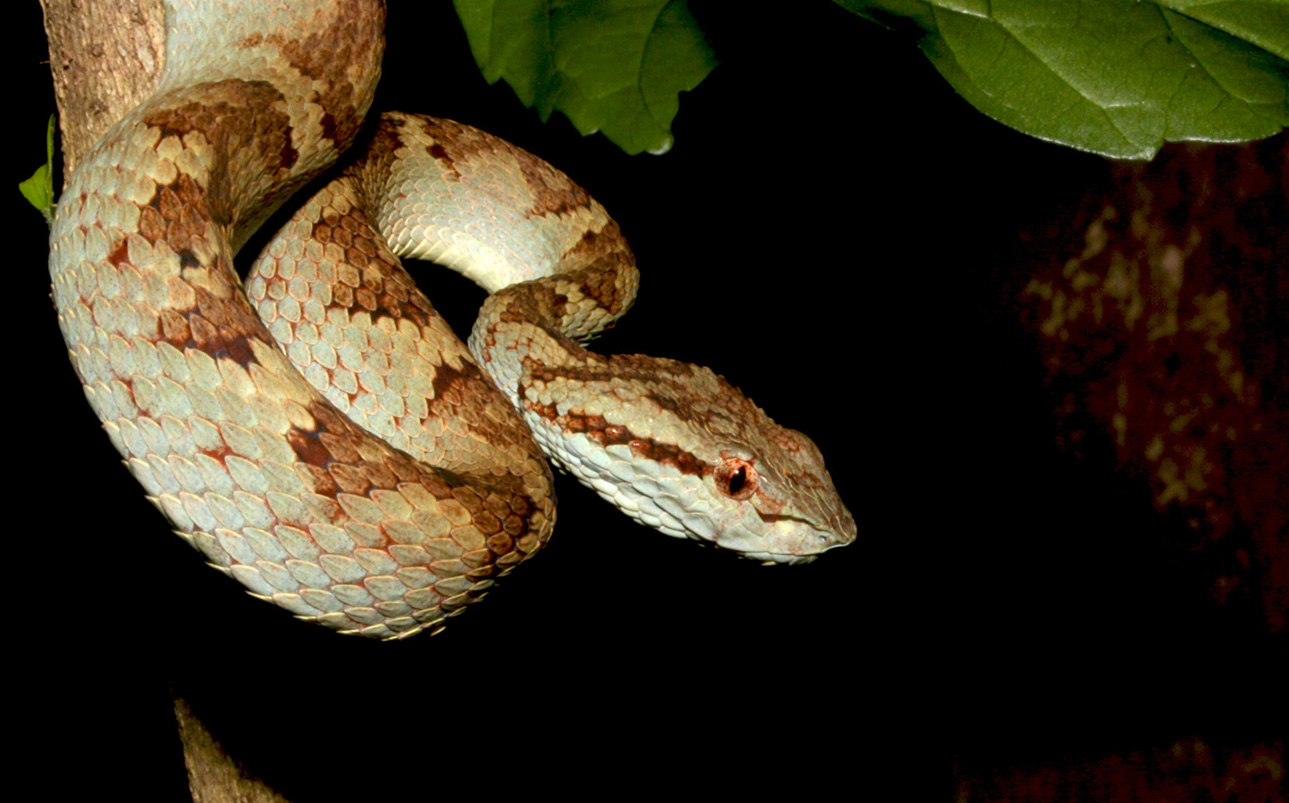
The Malabar Pit Viper Trimeresurus malabaricus is again a very variable snake. It frequents the highlands of SW India, and has dark, light, green and brown morphs!


The Bamboo Pit Viper


Our recent Big 4 snake rescue were a Russel's viper and you can get the full story here: http://bartramia.blogspot.in/2013/01/rescue-that-snake.html#.UPmpl_JyErw
and a multiple snake rescue :

The Noble Indian Cobra!


There have been many hits on this article as well as requests for more information, so I thought I would share some of the resources that I found most helpful:

1.Snakebite Envenomation in India: A Rural Medical Emergency Indian Pediatrics 2006;43:553-554http://www.indianpediatrics.net/june2006/june-553-554.htm
2. Kraits deliver some powerful neurotoxins that cause few initial symptoms at the site of the bite but can be deadly within a couple of hours. Detailed Instructions for Krait bites can be found here:  http://www-surgery.ucsd.edu/ent/DAVIDSON/Snake/Bungarus.htm *Note that Indian polyvalent antivenom is effective against Krait venom also.
3. The University of Adelaide's toxinology resources website has an excellent database of information on most of the poisonous snakes in the world, first aid, treatment, and antivenins. Use the search engine to find the information you need: http://www.toxinology.com/fusebox.cfm?fuseaction=main.snakes.search
4. Snakebite Research Unit, Little Flower HospitalAngamaly, Kerala - First Aid
5.A helpful interview with Romulus Whittaker in The Hindu: http://www.hindu.com/mag/2004/06/13/stories/2004061300400200.htm
6. Guidelines for the Clinical Management of Snake bites in the South-East Asia Region http://203.90.70.117/PDS_DOCS/B0241.pdf By the WHO is now a bit dated (1999).
7. "Snake Bite in South Asia: A Review" in PLOS Neglected Tropical Diseases (Jan 2010) http://www.plosntds.org/article/info%3Adoi%2F10.1371%2Fjournal.pntd.0000603
also here (same article) : http://ukpmc.ac.uk/articles/PMC2811174//reload=0;jsessionid=FBC1BE8828656BCE7CC2B211EA5EAB10
8. "Commissioned article: management of exotic snakebites"  Well worth reading even though it does not cover Indian snakes. 
http://qjmed.oxfordjournals.org/content/102/9/593.long 

IMPORTANT NOTE!!!
It is our instinctive reaction of fear, and the frenzy that follows it that leads to most of our snake 'problems'. In my experience, a snake, when it knows it's been spotted, will try to find some way to escape. If it is allowed to move out calmly, that is the end of that. 
Unfortunately, we don't want the snake to leave... we want to see it dead. All questions, such as whether it is venomous or not, are left to be discussed after the snake is well and truly dead!

Please leave the snakes alone, and if at all possible they will leave you alone too. What they are after are the rodents, frogs and insects that frequent our habitations. The poor snake only wants to do her hunting as quietly as possible and then disappear, so why not live and let live???

FOR MEDICAL PROFESSIONALS: HERE'S A GOOD PPT ON TREATING SNAKEBITE
Snakebite Management in India
View more presentations from Ashendu Pandey

http://bartramia.blogspot.com/2013/01/rescue-that-snake.html 


Digg!


SHARE THIS NOW

Google+ javascript:(function(){var now=new Date(),month=now.getMonth()+1;day=now.getDate();year=now.getFullYear();window.polarbear=window.polarbear||{};var D=550,A=450,C=screen.height,B=screen.width,H=Math.round((B/2)-(D/2)),G=0,F=document,E;if(C>A){G=Math.round((C/2)-(A/2))}window.polarbear.shareWin=window.open('https://www.polarbearapp.com/app','','left='+H+',top='+G+',width='+D+',height='+A+',personalbar=0,toolbar=0,scrollbars=1,resizable=1');E=F.createElement('script');E.src='//www.polarbearapp.com/js/web-bookmarklet.js?v='+month+'-'+day+'-'+year;F.getElementsByTagName('head')[0].appendChild(E)}());